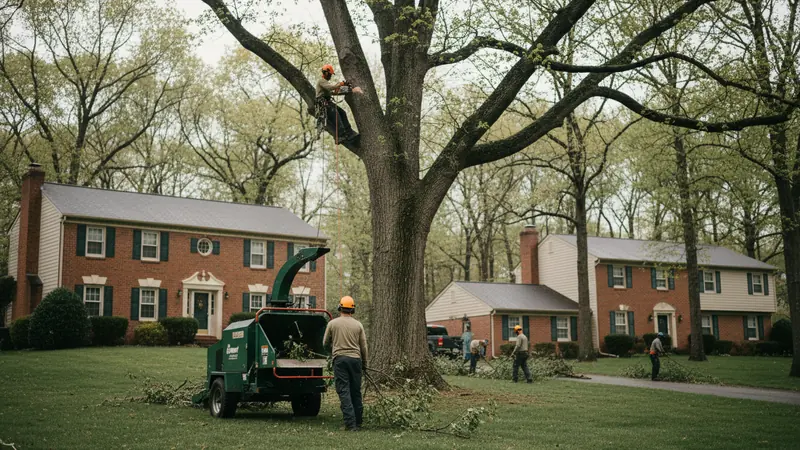
County approvals, fees and tree care in Fairfax’s protected woodland.
Every figure below carries its source and the date we gathered it. Earlier county facts keep their original dates.
Do you actually need permission?
Fairfax County generally allows owners to remove individual trees on private property. That does not give you permission to clear a lot. Before booking work, check whether the tree stands in a Resource Protection Area (RPA) or conservation easement. HOA rules and landscaping required by zoning can also restrict what you remove.
In an RPA, even removing dead, diseased, dying or invasive non-native vegetation requires county approval. You apply through PLUS, the county's online system, using the WAIV RPA record. Land Development Services (LDS) handles it. A dead tree is not, by itself, proof that you can skip this step.
Clearing more than 2,500 square feet requires a county permit. Within a floodplain, even a small clearing needs a permit or letter of permission. Where disturbance exceeds that threshold and another qualifying plan does not cover the work, the county requires a Rough Grading Plan. A Virginia-licensed design professional must certify it.
Describe the whole job. The gathered guidance does not settle how equipment access and stump work count toward disturbed area. Nor does it establish a universal emergency exception for hazardous trees in RPAs or easements. Ask LDS about the tree, access route and stump work together before treating a removal as exempt.
Source: Fairfax County, Tree Removal; LDS, Removing Vegetation in a Resource Protection Area, Reporting Land Development Concerns, and Rough Grading Plan. Gathered 2026-10-17.
What the county charges, and what remains unpriced
The RPA waiver has no application fee. You may prepare it yourself. Submit a plat or site exhibit that marks the vegetation you want to remove. Depending on the scope, the county may also need photographs or a professional report. A free county application does not mean an arborist's report or the tree work is free.
| County approval | Published fee supported by the gathered evidence |
|---|---|
| RPA vegetation-removal waiver | $0 application fee |
| Conservation-easement tree-work waiver | No current flat fee established |
| Approval for a formally designated protected tree | No current flat fee established |
| Larger clearing job | No single all-inclusive permit cost established |
For larger jobs, the plan type, review cycles, disturbed area and stormwater requirements affect which charges apply. Get the county's requirements for your scope before comparing a contractor's permit allowance with another bid.
We found no primary-source dataset establishing average Fairfax County homeowner prices for removal, pruning or stump grinding. The gathered contractor guides use different scopes. County procurement bids cover government work. Neither supplies a reliable average for your yard, so this page does not quote one.
When comparing written quotes, ask whether each includes hauling, stump grinding, chip removal, equipment access and lawn repairs. Have the provider identify anything priced separately. This is a way to compare the work offered, not a county fee rule.
Source: Fairfax County LDS, Removing Vegetation in a Resource Protection Area, for the waiver fee and required material. Gathered 2026-10-17. Other fees and residential prices remain gaps in the evidence gathered that day.
How long approval takes, and how inspections work
Fairfax estimates about five business days to review a complete RPA vegetation-removal waiver. That is a review estimate, not a promised date for the crew to start. A complex request can take longer and may need a discussion or site visit with the county Urban Forester.
Before submitting, mark the trees clearly on the plat or site exhibit. Ask whether the county needs photographs or a professional report for your request. Missing material can leave you waiting before the county has a complete request to review.
The gathered sources do not establish a routine final inspection after every standalone RPA waiver. They also give no standard deadline for inspecting replacement plantings. Read the conditions attached to your approval and ask LDS which visits or follow-up records your job needs.
Larger clearing projects follow a different process. Where land disturbance requires a conservation plan and involves removing, preserving or replacing trees or forest, Chapter 122 requires a tree conservation plan. It provides for periodic inspections of those activities. That does not establish the same inspection sequence for an individual backyard tree.
For a Rough Grading Plan, LDS releases the land-disturbance permit through PLUS after reviews, payment and approval conditions are complete. Do not treat the RPA review estimate as the timetable for that larger job.
Source: Fairfax County LDS, Removing Vegetation in a Resource Protection Area and Rough Grading Plan; Fairfax County Code, Chapter 122, Tree Conservation Ordinance, including its reference to Public Facilities Manual §12-0500. Gathered 2026-10-17.
Protected trees can leave work after the cutting
In an RPA buffer, removing a dead, dying or diseased tree brings a duty to replace vegetation with equivalent water-quality and environmental benefits. Fairfax prohibits clear-cutting and removing native vegetation to create lawns there. Approval to remove a failing tree does not turn the buffer into an area you can clear for grass.
Ask what replacement vegetation the county expects before agreeing on the contractor's scope. Keep that answer with the approval so the estimate can account for work after the tree comes down. The gathered evidence does not supply a universal replacement count or planting deadline.
Some trees have separate, formal protection under Chapter 120, the Heritage, Specimen, Memorial and Street Tree Ordinance. Owners must submit proposed maintenance, care or treatment to the Director for approval. When the Board of Supervisors permits removal of a designated tree, it may require a replacement.
LDS answers permit questions at 703-222-0801. Have your address and planned work ready. Ask which protections apply, what the approval must cover, and who will confirm that the job meets its conditions.
Source: Fairfax County LDS, FAQs: Resource Protection Areas; Fairfax County Code, Chapter 120. Gathered 2026-10-17. Phone: LDS, Does My Project Require a Permit?, gathered 2026-09-22.
Who is allowed to do the work?
Fairfax's tree-care guidance says tree and lawn care companies do not need a license to do business with consumers in Virginia. It recommends ISA-certified arborists without making that certification mandatory. It also cautions that some agencies require permits or licenses.
Trimming and below-ground work need different checks. Virginia DPOR says tree trimming alone generally needs no contractor license, while stump grinding or other below-grade work that disturbs land usually requires one. Read the county's general statement alongside that distinction. It does not settle every combined removal-and-stump contract.
Virginia's Landscape Service Contracting specialty expressly includes removing stumps and roots below grade. Other listed classifications and specialties also cover that work. Ask the provider which credential covers the complete scope; do not assume only one specialty can qualify. Fairfax's local home-improvement licensing requirement for standalone stump grinding remains unresolved in the gathered evidence.
Source: Fairfax County, Selecting an Arborist or Tree Care Company; Virginia DPOR, Storm Damage consumer alert; Virginia Administrative Code, 18VAC50-22-30, specialty services. Gathered 2026-10-17.
What Fairfax's housing age tells you about its trees
Fairfax's January 2024 inventory counts 434,745 housing units. Of these, 111,232 predate 1970, 83,129 date from 1970–1979, and 93,851 from 1980–1989. The table excludes mobile homes, dilapidated structures and group quarters.
Those dates describe houses, not their trees. We found no county study that compares tree failure or removal frequency by the decade a house was built. There is no supported numerical risk estimate here for an older split-level versus a newer house.
Hollin Hills offers a more useful local example. The county's design guidelines describe houses positioned around existing trees, mature landscaping, and streets and lots following wooded contours. Trees were part of how the neighborhood was laid out. That history explains why a tree job deserves attention to the whole site; it does not diagnose the condition of any tree today.
For your property, ask the arborist to assess the trees themselves and explain the proposed work. Have the crew describe access and what it would leave behind. House age alone cannot answer whether a tree needs treatment, pruning or removal.
Source: Fairfax County Department of Management and Budget, Demographic Reports 2024, table 6.10, inventory dated 2024-01-01, gathered 2026-09-22; Fairfax County, Hollin Hills Historic Overlay District Design Guidelines, page 28, March 2022, gathered 2026-10-17.